

From a package from the West to Vinted: The fascinating history of the used clothing market in Poland (1980-2025)
We invite you on a journey through four decades – from the gray PRL, through the crazy 90s, to today's era of circular fashion, in which second hand has become synonymous with a conscious choice.
The 80s – A Breath of the West in a Sea of Gray (The Beginnings of Used Clothing)
In the 1980s in Poland, the term "lumpeks" did not yet exist, and the used clothing market was practically absent from the official circulation. The shortage economy meant that dull mediocrity and textiles from people's democracy countries prevailed.
In this landscape, the real treasure was packages from the West. Sent by family from the FRG, USA, or France, they contained not only coffee and oranges but above all clothes. Used Wrangler jeans, a faded T-shirt with a foreign band's logo, or a colorful sweatshirt – these were symbols of status and a window to the world. Used clothing was then not a matter of saving money but a synonym of luxury and originality. Trade was mainly private, based on exchange or quiet "under the counter" sales at bazaars.
1990s – The great explosion: The birth of the "Thrift Store"
The real revolution came with the systemic transformation. The 90s were an explosion of the free market and unlimited possibilities. It was then that the thrift store was born (also affectionately called "ciuchland" or "szmateks" – the word comes from "lump" meaning 'rag' and "eks" from 'export' or 'exclusive', theories vary).
Why did Poles fall in love with thrift stores?
- Price: After years of shortage and in the face of rising unemployment, cheap clothes were a blessing.
- Quality: Western clothing, even used, often outclassed the quality of new products available at Polish bazaars.
- West: The possibility of wearing original brands (Levi's, Adidas, Esprit), which were symbols of aspiration to the Western lifestyle.
The first large-scale second hands appeared, often selling clothing by weight. The iconic moment became the "delivery day" – queues formed before opening, and the best bargain hunters (called "szperacze") could pick out real "gems" in a few minutes. Still, for many, shopping in a thrift store was a source of shame, something done quietly.
2000s – Second hand in the shadow of shopping malls
The new millennium brought stability to Poland and... shopping malls. The arrival of global fast fashion chains (like H&M, Zara, or Reserved) changed the rules of the game. Suddenly, new, fashionable clothing became cheap and widely available.
It seemed like the end for the used clothing market. However, thrift stores survived, undergoing their first professionalization. Instead of chaotic piles of clothes sold by weight, stores with priced clothing began to appear. They were cleaner, better organized, and offered selected goods. It was then that the concept of "vintage" began to sprout. Young people, bored with the repetitiveness of chain stores, started looking in second hands not only for savings but above all for a unique style.
2010s – The digital revolution and the triumph of "gems" (Vinted changes the game)
The real game changer turned out to be digitization. The emergence of platforms like Allegro, OLX, and above all Vinted , moved the trade of used clothing online.
What did it change?
- Availability: Suddenly every second hand was in your phone, 24/7.
- End of shame: Buying second hand became cool. Fashion influencers and bloggers began publicly showing off their “thrift store finds” (hauls).
- Monetization: Everyone could easily sell their unwanted clothes, becoming part of the cycle.
At the same time, ecological awareness grew. We started talking about the negative impact of fast fashion, about tons of clothes ending up in landfills. Used clothing stopped being just cheap and unique – it became conscious and ecological.
2020-2025 – The era of circular fashion and conscious consumers
Entering the third decade of the 21st century, we found ourselves in a completely new place. The COVID-19 pandemic, economic crises, and the accelerating awareness of the climate disaster have made circular fashion no longer a niche term but a main trend.
In 2025, the Polish second hand market is mature and diversified. We have:
- P2P (Peer-to-Peer) platforms: Vinted is the absolute hegemon, breaking popularity records.
- Traditional thrift stores: Still strong, especially in smaller towns, but increasingly operating like boutiques (e.g., premium second hand chains).
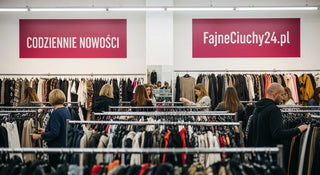
- Digital second hands: Online stores that select, clean, and professionally sell used clothing themselves (e.g., fajneciuchy24.pl).
- "Pre-owned" market (luxury second hand): Platforms specializing in selling used luxury goods (handbags, watches, branded clothing).
- Brand re-commerce: Brands themselves (e.g., Zalando, H&M) introduce resale options or "pre-owned" lines.
Buying used clothing in 2025 is no longer a shame or a necessity. It is a smart, conscious economic, ecological, and, most importantly, stylish choice.
More than a trend: The ecological dimension of used clothing
For decades, the thrift store was mainly seen through the lens of price. Today, in 2025, ecology has become the main motivation for millions of Poles. Awareness that the fashion industry is one of the biggest global polluters has radically changed our approach to shopping.
Why does second hand save the planet?
- Reducing the water footprint: Producing one cotton T-shirt consumes about 2700 liters of water. By choosing a second-hand T-shirt, you save that water entirely.
- Reducing CO2 emissions: The production and global transport of new clothing generate a huge carbon footprint. Used clothing most often circulates locally, and its reintroduction into the market does not require energy-intensive production.
- Less waste in landfills: Globally, every second a truck full of textiles ends up in a landfill. By shopping at a second hand, you literally save clothes from becoming waste and give them a second, sometimes third or fourth life.
Circular fashion (Circular Fashion) is a model where nothing goes to waste. Clothes are designed to last long and, after use, are easy to repair or recycle. Buying second hand is the simplest and most effective way to implement circular fashion principles in your own life. It's a real "less waste" action that has a direct impact on the environment.
Your wallet will love second hand: The financial phenomenon of second-hand fashion
The ecological aspect goes hand in hand with the financial one. Although Poles are wealthier than in the 90s, we have also become more conscious consumers. Inflation and economic uncertainty have made us look for smart savings (smart shopping).
Used clothing has ceased to be synonymous with "cheap stuff" and has become synonymous with "the best quality-to-price ratio".
- Quality over quantity: For the price of one new acrylic sweater from a popular chain store, you can buy a premium cashmere or wool sweater in a second hand. Second-hand clothes that have already survived one owner and washing often prove their high quality.
- Access to luxury (Pre-owned): The pre-owned market allows you to buy branded handbags, coats, or shoes for a fraction of their original price. It's the democratization of luxury but also a smart investment – some branded second-hand products hold their value or even appreciate.
- Circular economy (Vinted): P2P platforms like Vinted have created something revolutionary: almost zero cost-per-wear. You can buy a dress for a wedding and resell it for a similar amount after the event. Your real expense is minimal. Monetizing your own wardrobe has become a common way to earn extra budget.
- Uniqueness: In an era of global trends, where everyone in the shopping mall buys the same thing, thrift stores guarantee originality. Finding a "gem" is not only a saving but also a thrill and building a unique style.
The future of second-hand fashion: What awaits us after 2025?
The used clothing market in 2025 is mature, but the circular revolution is just gaining momentum. From an "alternative," it has become a key element of the fashion industry. What awaits us? Here are the 5 most important trends that will define the future of second hand in Poland.
1. AI and AR in the service of "gems"
Hours spent "browsing" online will become a thing of the past. The future is technology. Artificial Intelligence (AI) will create hyper-personalized recommendations for us by analyzing our style, size, and purchase history. The "gems" will find us themselves. Meanwhile, augmented reality (AR) will allow us to "try on" clothes from Vinted or digital second hand without leaving home, reducing the number of missed purchases and returns.
2. EU regulations and the end of "Ultra Fast Fashion"
This is not a trend, it's a certainty. The European Union has declared war on waste. The EU strategy for a circular textile economy will introduce, among other things, Extended Producer Responsibility (EPR). This means that fast fashion producers will have to pay for the collection and recycling of the clothes they put on the market. This will drastically increase the cost of cheap clothing and make circular fashion even more profitable.
3. "Re-commerce" will become the standard
Today, "buy back" or "resell" on well-known brand websites is a novelty. Tomorrow – a standard. Clothing brands, forced by regulations and consumer pressure, will massively open their own re-commerce platforms. They will encourage the return of old clothes they produced (in exchange for discounts) to reintroduce them into circulation or recycle them.
4. Hyper-specialization and "Curated Vintage" boutiques
The market will split. On one side will remain giants "everything for everyone" (like Vinted). On the other – niche, curated (ang. curated) second hand boutiques will flourish. Today we already see stores specializing exclusively in Japanese vintage, Y2K fashion (2000s), luxury handbags (the pre-owned luxury market), or Scandinavian minimalism. Consumers will look not only for bargains but above all for expert selection.
5. From "Recycling" to "Upcycling" and "Fiber-to-Fiber"
What happens to used clothing that is too damaged to wear? This is the biggest challenge of the industry. The future lies in "fiber-to-fiber" recycling technologies, allowing old textiles to be chemically or mechanically processed into new yarn. Before this happens on a mass scale, upcycling will dominate – creatively transforming old clothes into new, unique designs, which is already becoming a separate branch of fashion.
Summary: Used clothing – a history lesson that has become the future
The history of the used clothing market in Poland is a mirror reflecting our own transformation. We started with the desire for the West hidden in packages from the FRG. We went through the phase of being overwhelmed by cheap imports in the 90s thrift stores and the consumerism of shopping malls.
Today, in 2025, we return to our roots in a new form. Circular fashion and second hand are no longer just trade – they are a philosophy of conscious living. It's a financially smart, ecologically responsible choice and, most importantly, an absolutely unique style. And the Polish market, one of the most developed in EJaźwińskiurope, proves that the best "gems" are those that someone has already loved once.